SPECIES DESCRIPTION
RHAGADIOLUS STELLATUS
Including Rhagadiolus edulis
Family and Genus:- See- COMPOSITAE
Common Names:- Star hawkbit
Homotypic Synonyms:- Lapsana stellata.
Meaning:- Rhagadiolus (Gr) Divided.
Stellatus (L) With spreading rays, star-like.
General description:- Low to medium annual, usually sparsely hairy throughout.
Stems:-
1) 7-40 cm, usually branched, erect to spreading.
Leaves:-
1) 25-140 x 10-70 mm, mostly oblong-obovate, sinuate-dentate to lyrate-pinnatifid,
but the cauline sometimes ovate to lanceolate.
Flowers:-
1) Capitula, yellow, 7-10 mm, long pedunculate, borne in a lax spreading panicle,
occasionally with few flowers.
2) Involucre, 5-8 x 2·5-3·5 mm at anthesis, accrescent in fruit.
a) outer bracts, 5, very small, ovate, patent and stellate in fruit.
b) inner bracts, 5-8, narrowly linear-lanceolate, sometimes with a median row of
rigid hairs.
Fruit:-
1) Outer achenes, 10-15 x 1-1·5 mm, curved, forming a characteristic radiating
infructescence.
Key features:-
1) Leaves not spiny.
2) At least some achenes without pappus.
3) Outer involucral bractsp enfolding achenes, patent and stellate in fruit.
Habitat:- Seasonally damp habitats in fallow fields, olive groves, open dry shrubby
vegetation and open wood-land. 0-800(-1400) m.
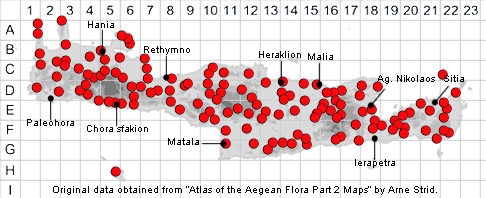
Distribution:- Widespread and common throughout the Mediterranean. Widespread
and common on Crete.
Flowering time:- Mar to early June.
Photos by:- Steve Lenton
~~~~~~~~~~~~~~~~~~~~~~~~~~~~~~~~~~~~~~~~~~~~~~~~~~~~
RHAGADIOLUS EDULIS Back to Top
Homotypic Synonyms:- Lampsana edulis, Rhagadiolus stellatus subsp. edulis
Rhagadiolus stellatus var. edulis
Edulis (L) Of food, edible.
Resembling R.stellatus but differing in the following characters:-
1) Basal leaves, lyrate-pinnatisect with a large, rounded terminal lobe.
2) Inner phyllaries, usually 5, glabrous dorsally
3) Achenes, straight or slightly recurved
Habitat:- As for R.stellatus
Distribution:- Widespread and common throughout the Mediterranean. Previously
unrecorded from Crete.
Flowering time:- Mar to early June
Photos by:- Fotis Samaritakis and A,N.Other
